
Specialist medical review
Your exact diagnosis, disease stage, MRI findings, and current neurology treatment guide every protocol decision before you travel.

Multi-day, hospital-coordinated stem cell and exosome programs for chronic, progressive, and post-injury neurological conditions — designed individually around your diagnosis and goals.
Neurological stem cell treatment program in Istanbul
Overview
Living with a chronic, progressive, or post-injury neurological condition affects mobility, independence, energy, and family life. Our neurological program is designed for patients and families seeking individualized regenerative medicine protocols in Istanbul alongside their ongoing home neurologist care.
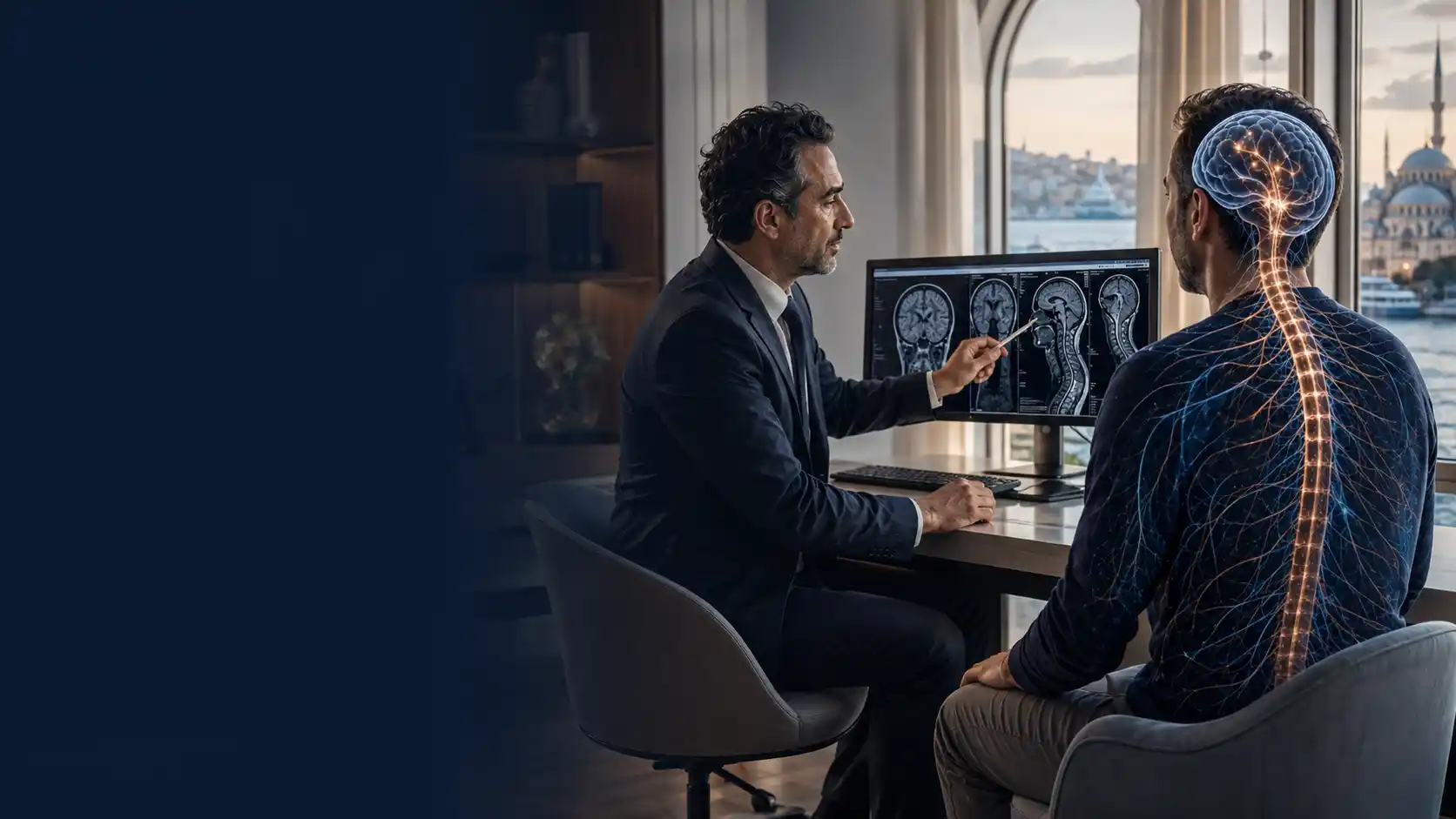
Every treatment plan is individualized. Before recommending any protocol, our physicians review your neurological history, MRI imaging, and current medications, then explain how Wharton's jelly-derived mesenchymal stem cells (WJ-MSCs) and WJ-MSC-derived exosomes work to calm central and systemic neuroinflammation, modulate overactive microglial and T-cell pathways, and release neurotrophic factors (such as BDNF, GDNF, and VEGF) that help protect and support stressed neurons, myelin sheaths, and synaptic circuits.
Reviewed by: Uzm. Dr. Cihan Bolat · Reviewed · Re-review due
A journey inside the tissue
Every neurological program in Istanbul is structured around four clinical pillars that combine biological precision with hospital safety.
Our clinical methodology
Every neurological program in Istanbul is structured around four clinical pillars that combine biological precision with hospital safety.
Your exact diagnosis, disease stage, MRI findings, and current neurology treatment guide every protocol decision before you travel.
We work with fresh, non-cryopreserved Wharton's Jelly mesenchymal stem cells (WJ-MSCs) and WJ-MSC-derived exosomes with documented viability, purity, and cell counts.
Hospital-monitored intrathecal WJ-MSC administration (with or without sedation), intravenous WJ-MSC and exosome infusions, and intranasal exosomes are selected specifically for your neurological presentation.
Your Istanbul stay includes post-procedure medical observation, a written biological treatment summary, and structured 1, 3, and 6-month follow-up alongside your home neurologist.
Conditions we treat & evaluate
Select your condition below to explore biological mechanisms, our treatment protocols, published human research, 2026 pricing, and how to request a free medical evaluation.
Immunomodulatory, myelin-supportive, and neuroprotective WJ-MSC & exosome pathways for relapsing and progressive MS.
Individualized neurotrophic and neuro-immune protocols supporting dopaminergic and motor pathways.
Supportive regenerative protocols targeting neuroinflammation, synaptic resilience, and cerebral microcirculation.
Targeted WJ-MSC and exosome protocols supporting peripheral nerve microcirculation, Schwann cells, and axonal comfort.
Post-stroke intrathecal, intravenous, and intranasal WJ-MSC and exosome protocols supporting neuroplasticity and peri-infarct repair.
Intrathecal and intravenous WJ-MSC and exosome protocols targeting spinal neuroinflammation and spared tract support.
Intrathecal and systemic WJ-MSC and exosome protocols supporting motor neuron neurotrophic signaling and glial balance.
Multi-day pediatric and adult WJ-MSC and exosome protocols supporting white-matter trophic signaling, tone, and motor coordination.
Biologics & delivery routes
After reviewing your medical records and MRI imaging, our medical team selects the biological preparations and administration routes that match your diagnosis and therapeutic objectives.
Performed in a hospital setting with or without sedation depending on clinical circumstances. Delivering Wharton's jelly MSCs directly into the cerebrospinal fluid bypasses the blood-brain barrier to support central immunomodulation, calm neuroinflammation, and release neurotrophic factors near neural tissues.
Systemic infusion of fresh Wharton's jelly-derived mesenchymal stem cells (WJ-MSCs) designed to modulate peripheral-to-central inflammatory signaling, regulate cytokines, and provide systemic paracrine trophic support.
Systemic delivery of nanoscale extracellular vesicles carrying growth factors, regulatory microRNAs, and signaling proteins that influence intercellular communication and complement cell-based therapy.
A non-invasive nasal application studied along the olfactory and trigeminal neural pathways as a needle-free complement to systemic or intrathecal protocols, while recognizing that the exact fraction reaching specific human brain regions remains under study.

Hospital · with or without sedation
Delivers Wharton's jelly-derived mesenchymal stem cells (WJ-MSCs) directly into the cerebrospinal fluid (CSF) rather than relying on intravenous cells to cross the blood-brain barrier. Investigated for neuroinflammation, immunomodulation, and neurotrophic signaling closer to the central nervous system, and performed in a qualified hospital with or without sedation depending on clinical circumstances.

Hospital or clinic · monitored
The systemic route for Wharton's jelly-derived MSCs and WJ-MSC exosomes (alongside optional NAD+, multivitamin, and high-dose vitamin C infusions in rejuvenation programs). Investigated for systemic immunomodulation, cytokine balance, M1-to-M2 macrophage polarization, and whole-body paracrine signaling.

Hospital or clinic · non-invasive
A gentle, non-invasive nasal application of Wharton's jelly MSC-derived exosomes investigated for transport along olfactory and trigeminal pathways toward central nervous system structures. It is a surface nasal application (never a nerve injection), and the exact fraction reaching specific human brain regions remains under study.
The full route atlas
Eight application routes, planned one case at a time. The routes featured on this page are marked in copper.
Individualized evaluation & clinical transparency
Our medical team reviews your neurological history, MRI scans, and current medications to design an individualized Wharton's jelly MSC and exosome protocol, explaining the proposed routes, intended biological mechanisms, and itemized costs before you travel to Istanbul.
FAQ
Request Free Medical Evaluation
Share your case in confidence. Our international coordinators review every enquiry and respond within 24 hours, in your language.